Martin Luther sparked a whole lot more
 I saw a terrific television presentation recently by Rick Steves, the world traveler, about the surprising ripple-out effect of an action in 1517 by Martin Luther, German theologian, monk, and professor. As many of us have heard in church, Luther thought he was just posting some theological ideas for academic discussion where he taught at the University of Wittenberg. But those “95 theses” sparked a fire that spread throughout the Western world.
Many centuries later, that’s why we call October 31st “Reformation Day.” On that day many kinds of Christians remember the “Protestant Reformation” as a time of new awakening. That wave of revolutionary thinking sparked by Martin Luther was extended with variations by several other world religious leaders. It became a messy, violent time, when the new thoughts about faith intermingled with the peasant wars that ultimately abolished the oppressive feudal system. But new life came out of it on all sides, including some aspects of reformation in the Catholic Church.
Luther’s “95 Theses” were differences of thought and practice from the majority Catholic practices 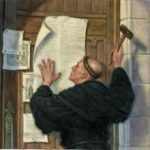 at that time. Luther hoped for just a new round of theological debates at the University of Wittenberg. But his criticisms and conviction that everyone should be able to read the Bible for themselves lit a fire that engulfed the peoples of surrounding countries far and wide.
Other leaders led similar theological streams in their own cultural contexts, including John Calvin in Switzerland, Thomas Cranmer in England, and John Knox in Scotland. There had also been courageous precursors, like Jan Hus in what’s now the Czech Republic, and Menno Simons in what is the modern-day Netherlands.
Luther’s objections sparked far more than he had imagined, but future generations gained deeper understandings of the Bible and felt a more direct relationship with God.
These days we have plenty of diversity among Christian beliefs. I hope we can put more energy now into acknowledging our common ground and welcoming everyone, Christian and non-Christian, as beloved children of God.
Yours in faith,
Betsy